


Kinesiology tape is a stretchy tape. It supports your muscles and joints while you heal and doesn’t lock them in place. The goal is to ease pain, help clear swelling, and give your body better feedback about how it’s moving. You’ve probably seen it on an athlete’s shoulder and wondered what it’s really doing.
How long it stays on is the other half of the question. No single number fits everyone, and we won’t guess at one here. Below, we cover what the tape does, what changes how long it lasts, and what to ask your therapist when you get it.
What kinesiology tape is made to do
The flexibility is deliberate. The tape mimics the elasticity of human skin, so you keep your full range of motion and still get some structure around a weak or sore area.
That’s the big difference from a rigid brace or wrap. A brace holds a joint still. Kinesiology tape is closer to a safety net: it gives a weak or injured joint some backup without restricting how you move.
At North Platte Physical Therapy, we use it to support muscles and joints during recovery, reduce swelling, and help your body’s natural healing response.
How it works on your skin
Once the tape is on, it gently lifts the top layer of skin. This creates a microscopic space between the skin and the muscle underneath. That decompression may change how your brain processes pain signals and can improve circulation in the area.
Here are four ways it can help:
- Pain management. The tape may interrupt pain signals sent to the brain, which can ease discomfort.
- Less inflammation. Lifting the skin may encourage lymphatic drainage, which can help clear out swelling.
- Neuromuscular re-education. The feel of the tape on your skin gives your brain extra information, which helps it coordinate muscle movements.
- Structural support. A weak or injured joint gets a little backup while you keep moving.
Don’t think of it as a cast or a brace. The tape gives your body small nudges and cues while you move.
What we use it for
Therapists often reach for kinesiology tape with sports injuries. Runner’s knee, shin splints, and shoulder instability are common examples. If running is what brought you in, our running injuries page explains how we approach those problems.
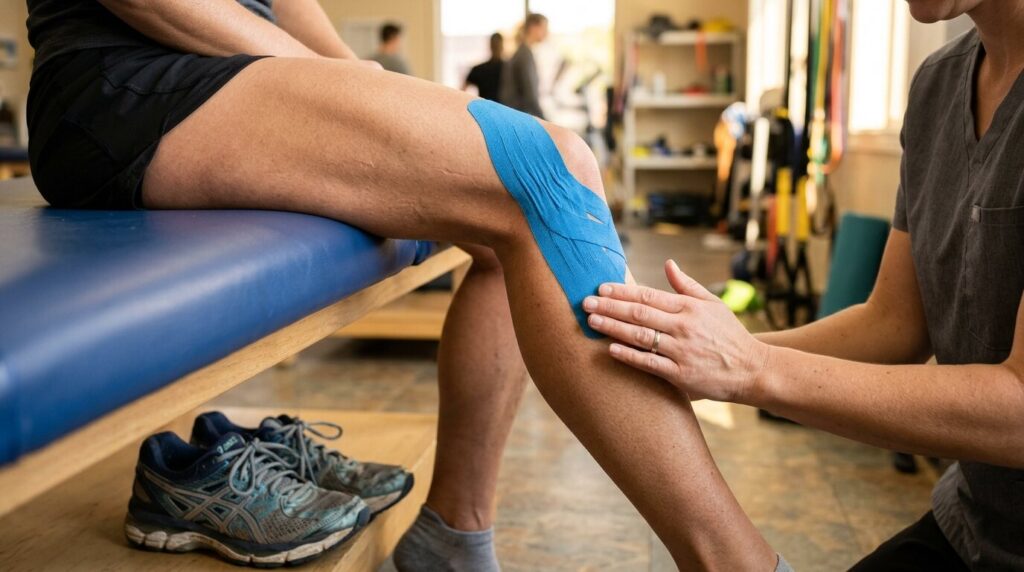
It’s also used for longer-running problems like lumbago (low back pain) and carpal tunnel syndrome. Some patients find it helps them hold better posture, and it can protect muscles from over-extension in everyday activities. Reaching overhead, lifting, and sitting at a desk for hours are good examples.
Whether tape makes sense for you depends on what’s happening in your body, and a therapist needs to look at that first. Tape that helps one person’s shoulder may do little for someone else’s.
How long does kinesiology tape stay on?
We can’t give you one timeframe, because it differs from person to person. Several things shape it:
- Your skin. Some people’s skin holds the adhesive well. Others get irritation or the tape loosens sooner.
- How you use the area. A runner’s knee gets a lot more motion than a shoulder you’re resting.
- Sweat, water, and friction. Heavy workouts, bathing, and clothing rubbing on the edges all affect how well the tape sticks.
- Where it’s placed. Tape over a joint that bends often has more to put up with than tape on a flatter spot.
- Why you’re wearing it. The goal of the tape, whether pain relief, swelling, or support, changes how it’s applied and how you use it.
Your therapist can tell you what to expect in your situation and how to remove the tape. They can also explain how to care for it while it’s on, including what to do about showering. If it starts to itch or irritate your skin, tell your therapist. Don’t wait it out.
If you want a specific answer, call your nearest clinic or use the contact form on our kinesiology taping page. We’d rather give you advice that fits your body than a number that doesn’t.
Tape works best as part of a bigger plan
Taping isn’t meant to be the whole treatment. It works best as one part of a full physical therapy program.
When the tape has given you enough support and pain relief, the focus shifts to strengthening the tissues underneath. That’s how you keep the same injury from coming back. The tape lets you stay active and move with confidence while your body finishes healing. The exercises and hands-on work build the lasting recovery.
Tape can sit alongside other tools too. Some patients also use therapeutic modalities as part of their plan. Your therapist decides the mix based on what your evaluation shows.
What to ask at your visit
A few questions can make the tape more useful to you:
- What is this tape meant to help with in my case?
- How should I expect it to feel, and what’s not normal?
- How should I care for it, and how do I take it off?
- When will we move on to strengthening, and what should I be doing at home?
- When should I come back, or call, if something feels off?
Tell your therapist anything you’ve noticed about your skin, like past reactions to adhesives or bandages. It helps them plan around it.
Your therapist can give you a real answer on wear time once they’ve seen you. If you’d like to find out whether taping fits your recovery, read more about our kinesiology taping service or reach out to one of our 17 clinics across Wyoming and western Nebraska.
Frequently asked questions
What does kinesiology tape actually do?
It gently lifts the top layer of skin and creates a tiny space between the skin and the muscle. That can change how your brain processes pain signals, improve circulation, and help clear swelling. Your joints also get support without any restriction on movement.
How long does kinesiology tape stay on?
It varies. Your skin, your activity level, sweat and water exposure, and where the tape is placed all play a part. Your therapist can tell you what to expect in your situation, and you can contact your nearest NPPT clinic to ask.
Is kinesiology tape the same as a brace?
No. A brace holds a joint still. Kinesiology tape is flexible and mimics the elasticity of your skin, so you keep a full range of motion and still get support.
Does the tape fix the problem on its own?
Not usually. It works best as part of a full physical therapy program. Once the tape has provided support and pain relief, therapy moves on to strengthening the tissues underneath, which helps prevent future injury.