

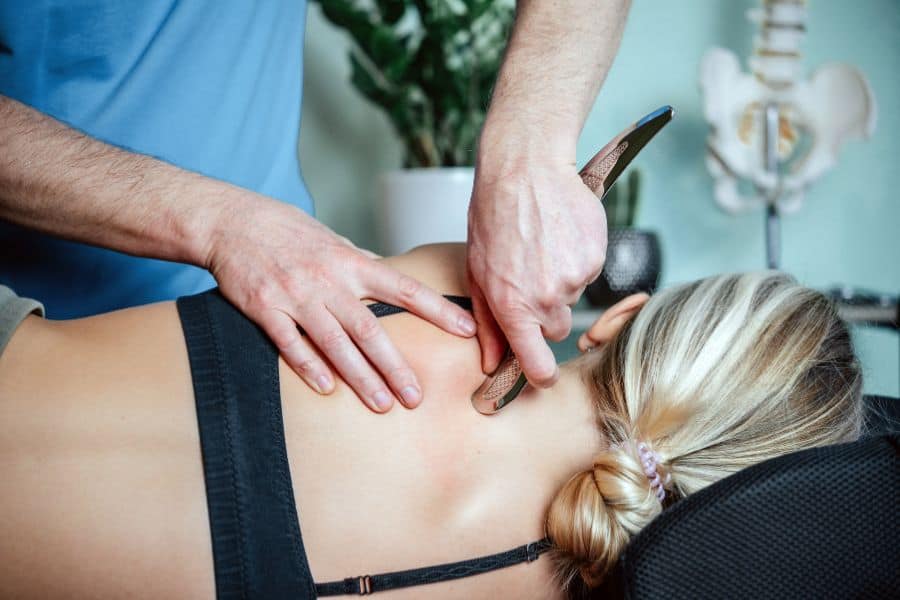
Neither one wins across the board. They’re different tools for different problems, and the right pick depends on what’s going on in your tissue. Graston Technique uses stainless steel instruments to find and break up scar tissue and adhesions. Cupping uses suction to lift the skin and the fascia beneath it.
Some people need one, some need the other, and some do well with both. Below, we cover how each works, where they overlap, and how to tell which fits your pain.
How the Graston Technique works
The Graston Technique is a form of instrument-assisted soft tissue mobilization, often shortened to IASTM. Your therapist glides specially designed stainless steel tools over your skin. The tools go deeper than hands alone, so they can pick up on things a manual massage might miss.
Our therapists compare the instruments to a stethoscope. They let us find internal scar tissue and knots by feel. When we locate a restriction, the textured edge of the tool helps release tight fascia and smooth out damaged fibers.
Treatment does a few other things too:
- It increases blood flow to the area, which prompts your body’s natural repair response.
- Regular sessions help clear out cellular waste and lower chronic swelling.
- Once restrictions are cleared, muscles can move through a fuller range of motion.
Put simply, Graston is a hunt-and-break-up approach. It’s built for finding the exact spot where tissue has stuck, thickened or scarred.
How cupping therapy works
Cupping therapy goes the other way. Massage and instrument work press down into the tissue. Cupping uses negative pressure to pull tissue upward. The suction lifts the skin and the fascia below it, which creates space.
That space matters. Once the fascia lifts, nerves and blood vessels have more room to do their jobs. Our therapists aim for the following with it:
- Tissue decompression: lifting the fascia gives nerves and blood vessels room to function better.
- Increased circulation: suction draws fresh, oxygenated blood into the treated area.
- Trigger point relief: it helps unstick muscle fibers that cause localized or referred pain.
- Better lymphatic flow: this helps the body clear metabolic waste more efficiently.
Cupping works by decompression. It’s less about hunting down one scarred spot and more about easing tight connective tissue and encouraging blood flow.
The main differences side by side
If you only remember a few things, make it these.
- Direction of force. Graston glides a tool across the skin to work into the tissue. Cupping pulls tissue up with suction.
- Main goal. Graston focuses on detecting and breaking up fibrotic tissue and adhesions. Cupping focuses on decompression, circulation and releasing tight connective tissue.
- Equipment. Graston uses stainless steel instruments. Cupping uses cups that create suction.
- Feel for the therapist. The Graston tools act like a stethoscope, so they double as a way to find problem spots, not just treat them.
Both aim to lower pain, loosen tight tissue and improve movement. They just take different routes.
When Graston may be the better fit
Graston tends to make sense when the problem looks like scar tissue, adhesions or a stubborn, localized restriction. We often use it for:
- Plantar fasciitis
- Carpal tunnel syndrome
- Repetitive strain injuries like tennis elbow
- Postsurgical scar tissue
- Chronic neck and back pain
Maybe you’ve got a tight band you can almost point to. Or movement that never came back after an injury or surgery. That’s the situation Graston was designed for.
When cupping may be the better fit
Cupping often suits broader tightness, soreness and stuck muscle fibers. We use it for chronic back and neck pain and for repetitive strain injuries like tendonitis. Athletes use it too, to reduce muscle soreness and support performance.
It can help after surgery as well. Patients recovering from an operation sometimes find it useful for managing scar tissue and restoring flexibility in restricted areas.
You’ve probably noticed that chronic neck and back pain and scar tissue appear on both lists. The overlap is real. For some people either tool could be a reasonable choice, and the decision comes down to how your tissue responds and what your therapist finds during the exam.
Neither one works alone
Soft tissue work loosens things up, but it doesn’t keep them loose. With Graston, we pair the treatment with specific stretching and strengthening exercises. Once the restrictions clear, your muscles can move through a full range of motion without pain. The exercises then help your joints stay flexible and more resilient against recurring tension.
Your plan might also include other hands-on options. We offer trigger point dry needling and a number of therapeutic modalities. If a tight muscle isn’t responding to one method, a therapist can adjust the approach rather than repeating the same thing.
How to decide
Choosing between these two on your own is hard. The pain can feel identical whether it comes from scar tissue, a trigger point or an overworked tendon. A physical therapist can watch how you move, find where the tissue is restricted and suggest the method that matches.
It helps to bring a few details with you:
- Where the pain sits and whether it stays put or travels
- How long you’ve had it
- Any past surgery or injury in that area
- What makes it better or worse during the day
We have 17 clinics across Wyoming and western Nebraska, so there’s likely one within reach. Pick a location in the contact form on either service page, then choose New Patient as your reason for contact.
Graston breaks up scar tissue and adhesions with stainless steel tools. Cupping lifts tissue with suction to ease tension and boost circulation. Which one helps most depends on your pain, and a good exam beats guessing. To read more about the approach that sounds closest to your situation, start with the Graston Technique page or the cupping therapy page, then reach out to the clinic nearest you.
Frequently asked questions
Is Graston Technique or cupping better for muscle pain?
Neither is better for everyone. Graston is built to find and break up scar tissue and adhesions. Cupping uses suction to decompress tissue and improve circulation. After an exam, a therapist can tell you which fits your pain.
Can Graston and cupping be used for the same conditions?
The two overlap some. Both are used for chronic neck and back pain and for scar tissue after surgery. Graston is also used for plantar fasciitis, carpal tunnel syndrome and tennis elbow. Cupping is often used for tendonitis and athletic muscle soreness.
Do I need exercises along with these treatments?
To help your recovery last, we combine the Graston Technique with specific stretching and strengthening exercises. Soft tissue work clears restrictions. The exercises help your muscles and joints keep moving well.
How do I get started at North Platte Physical Therapy?
Use the contact form on our website. Choose your nearest location, select New Patient as the reason for contact and send it in. Our clinics are in Wyoming and western Nebraska.